
Introduction
Electric motors are an integral part of modern life, powering everything from household appliances to industrial machinery. Their widespread use and diverse applications have revolutionized the way we live and work. In this blog post, we will take a deep dive into the fascinating world of electrical motors, exploring their mechanics, working principles, and various types, including brushless DC motors (BLDC motors), 3-phase and single-phase induction motors (AC motors), and more. Let’s unlock the secrets behind these ingenious machines that drive our world forward.
1. The Basics of Electrical Motors
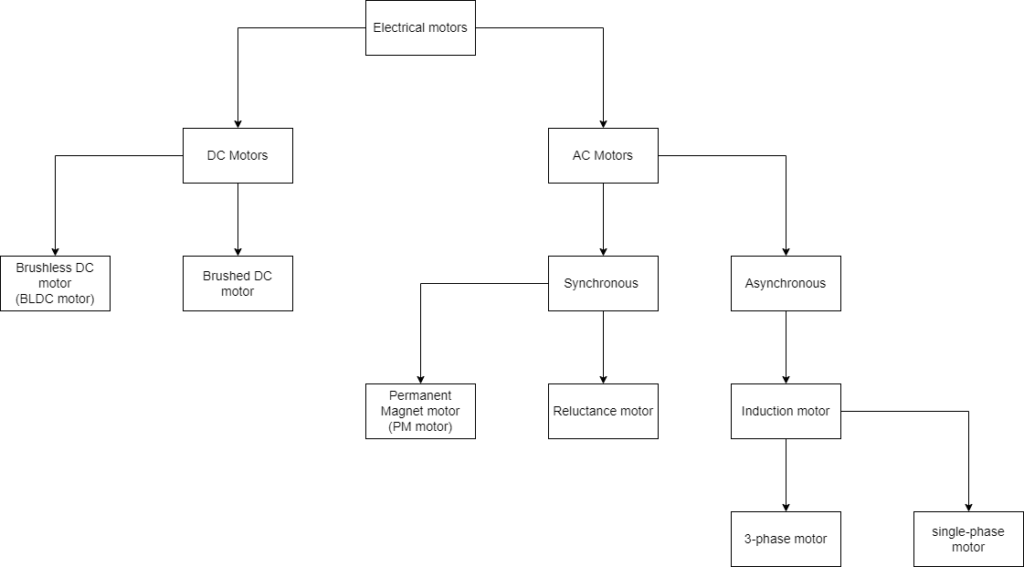
Before we delve into the intricacies of electrical motors, let’s start with the basics. An electric motor is a device that converts electrical energy into mechanical energy. It operates on the principle of electromagnetism, where the interaction between electric current and magnetic fields generates motion. There exists different types of motors, they can be divided in groups of which type of electricity they require to operate, AC or DC, or if they have permanent magnets or not. The figure below showcases the different types of motors.
2. Understanding the Inner Workings
At the heart of every electric motor lies the interaction between magnetic fields and electric current, which creates a force that drives the motor’s rotation. This fundamental principle is the cornerstone of its operation.
Electromagnetic Principles: An electrical motor consists of two essential components – a stationary part, known as the stator, and a rotating part, known as the rotor. The stator is either equipped with permanent magnets (PM and BLDC motors), a squirrel cage (AC motors) or electromagnets (coil which is energized) (DC motors) that create a stationary magnetic field, while the rotor carries conductive coils that respond to this magnetic field.
Magnetic Fields and Coils: When electric current flows through the coils in the stator, a magnetic field is induced, causing the rotor to experience a force and rotate. As the rotor turns, the magnetic fields of the rotor interact with the magnetic fields of the stator, ensuring continuous motion.
Commutation: For AC, PM and BLDC motors the commutation happens through sequential energizing of the stator coils in such manner that a rotating magnetic field is formed, this interacts with the magnetic field of the rotor which results in rotation. AC motor can use the 3 phases directly from the grid, to spin. However, PM and BLDC motors require a electronic controller, to time the sequencing of energizing the coils, in order to rotate. For brushed DC motors, commutation is the process that switches the direction of current flow in the rotor coils to maintain a rotation.
3. Permanent Magnet Motors and Brushless DC Motors: Efficiency and Precision
PM motors and BLDC motors are a revolutionary advancement in motor technology. Unlike their counterparts, BLDC motors do not require brushes, commutators and squirrel cages for operation. Instead, they utilize electronic controllers to precisely energize the coils, making them more efficient, reliable, and low-maintenance.
4. Exploring 3-Phase AC Motors: Powerhouses of Industry
3-phase AC motors are widely used in industrial applications due to their robustness and power capabilities. As the name suggests, they operate on a three-phase electrical supply, which creates a rotating magnetic field and drives the motor’s rotation. Their ability to deliver consistent and powerful performance makes them the workhorses of various industrial processes.
5. Unveiling Single-Phase Motors: Simplicity and Versatility
Single-phase motors are widely used in domestic appliances and small machinery, they are mostly similar in their functioning to a 3 phase induction motor. However, they operate on a single-phase electrical supply, making them simpler to use at places where only a single phase is available, as e.g., outlets in you home. The tricky part about using only a single-phase for a motor is that the rotation of the magnetic field is unidirectional, therefor it is need to have a second phase on order to determine the rotation direction. This is made by using a capacitor which shifts the voltage by so it can be used as a second phase.
6. Electrical Drives: A Crucial Link in Motor Control
Electrical drives play a vital role in motor control, converting electrical energy into the appropriate form to drive the motor at the desired speed and direction. They enable precise control over motor operations and are instrumental in optimizing energy consumption and performance.
7. The Future of Electrical Motors: Advancements and Sustainability
The future of electrical motors holds exciting prospects, with ongoing research and innovations focused on increasing efficiency, sustainability, and reliability. Researchers are exploring advanced materials, novel design concepts, and eco-friendly technologies to create greener and more sustainable motor solutions.
Conclusion
Electrical motors are the unsung heroes that power our world, driving progress and innovation across industries. Understanding their mechanics and working principles is essential to harness their potential efficiently. From BLDC motors to AC motors, PM motors, and beyond, the diverse array of motor types offers a multitude of solutions to cater to various applications. As we journey toward a greener and more electrifying future, the development of sustainable motor technologies will continue to shape the world of electromechanical systems.