
The super short explanation for the difference between Permanent Magnet Synchronous Motors (PMSMs) and Asynchronous Induction motors (AC motors), is that PMSMs utilizes Permanent Magnets (PMs) in the rotor, to create the magnetic field, instead of a magnetizing current as AC motors. This reduces the power consumptions giving the PMSMs a generally higher efficiency and more compactness. That being said, all the components besides the rotor are more or less eqaul for the two types of electric motors.
Interested in more? Let’s dive into it!
How does PMSMs function
The opperation of PMSMs can be simply explained by the principle of magnetic attraction. As you probably know, opposite magnetic poles attarcts each other and similar magnetice poles reppel each other. Thefore by creating rotating magnetic pole pairs by use of sinousiodal electical current in the stator windings, it is posible to attract the magnetic poles pairs of the rotor with PMs, which results in a synchronous motion between the frequnecy of AC current and mechanical shaft speed. This is oppsite to asynchronous motors which are requiring a slip, to be able to induce a magnetising current in the rotor bars.
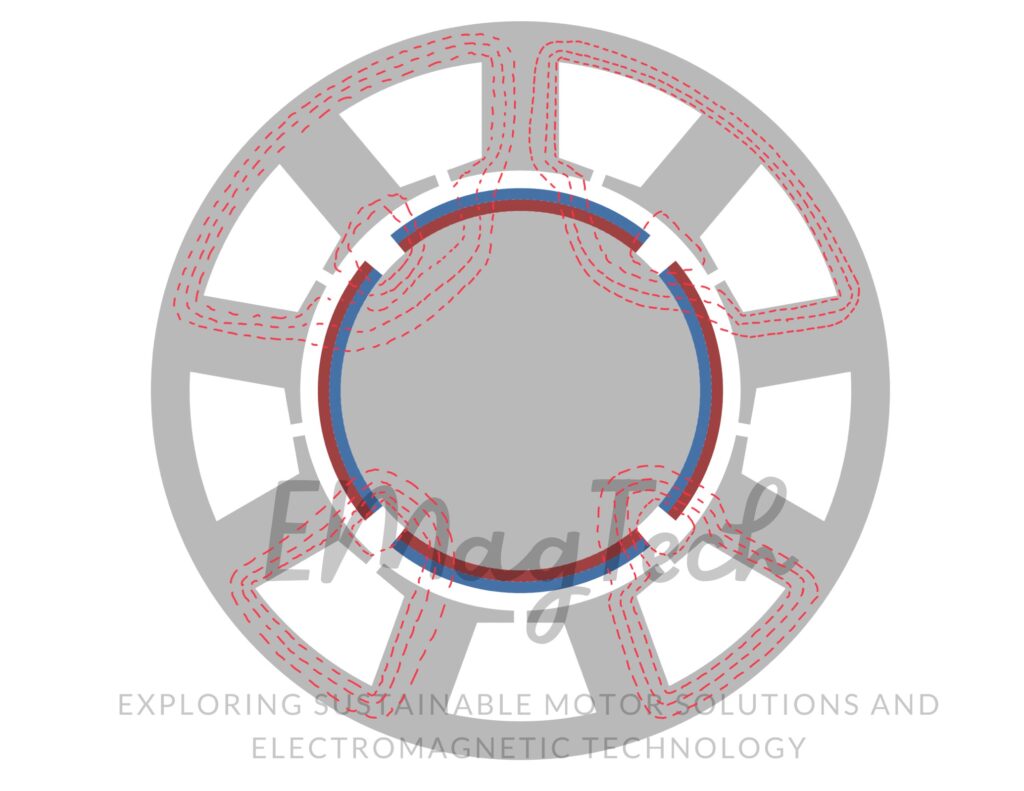
The most common varieties of PMSMs
PMSMs can have either an inner or an outer rotor configuration, depending on the placement of the rotor relative to the stator. Inner rotor PMSMs have the rotor positioned inside the stator, while outer rotor PMSMs have the rotor located outside the stator. Each configuration have pros and cons.
| Inner rotor | Outer rotor |
| Pros: – Better cooling of stator core and winding – Usually higer ingress protection – Longer lifetime – Standardised designs avaliable (IEC & NEMA) Cons: – Lower copper fill factor – Motor material usage | Pros: – Higher copper fill factor – Larger airgap diameter – Simple magnetic design Cons: – Less heat desipated through housing – No standard designs for easy replacement – Shorter lifetime |
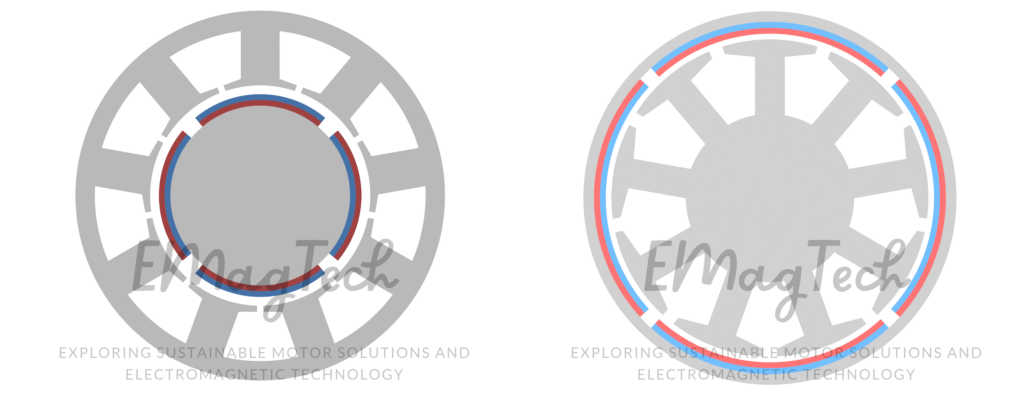
Inner rotor PMSMs can also vary in the arrangement of the permanent magnets in the rotor. They can have surface-mounted magnets, where the magnets are affixed to the surface of the rotor, or inset magnets, where the magnets are embedded within the rotor structure.
The rotors with surface mounted permanent magnets are generally and older approach which doesn’t have many benefits today, compared to rotors with inset permanent magnets.
The rotors with inset permanet magnets typically has a lower loss due to less induced eddy currents, the magnets are also cooler since they are sorrounded with steel, it is posible to make a flux concentrating structure resulting in a higher flux density in the airgap and at last it allows to utillise reluctance torque. All this makes the motor more efficient and more compact.
Operation of PMSMs
Another key difference of the PMSMs, compared to AC motors is the way they are operated. AC motors can be operated as Directly On Line (DOL), meaining that they can be operated just be connecting it to the 3 phase comming from the public grid. This is unfortunatly not the case for PMSMs. For PMSMs to get the maximum torque, it is needed to allign the curret in the place where it produces the most torque. To do this the motor must be opearated in a closed loop where the applied voltage must be realted to the rotor position. Therfore it is needed to use and Variable Frequency Drive (VFD) to operate the PMSM. Int the early days of PMSM, it was also needed to use a position sensor, e.g. an encoder or resolver, but now days, most modern VFDs have algorithms to estimate the rotor position by injecting some higher frequency current and evalutaing the position based on this. And the motor can therefore be oprated in open-loop, with a virtual feedback.
Pros and Cons of PMSMs
PMSMs offers some benifts compared to traditional AC motors, In this section we will sum up what the pros and cons of the PMSMs are compared to the alternatives.
| Pros | Cons |
| – High energy efficiency – Precise speed (No slip) – Higher torque per volume | – PM material cost – Need a VFD to operate – High frequency noise from VFD switching |
High efficiency:
PMSMs have a constant magnetic field from the permanent magnets (PMs), therefore it is not needed to use energy on creating a magnetic field. this leads to less current passing through the conductive parts and therby the losses are reduced.
Precise speed:
As the PMSM is a sychronous motor, the motor doesn’t have a slip, which means that the motor will run at the fundamental frequency it is provided, and the number of pole will act as a gearing ratio.
Higher torque per volume:
In general electical motors size are dependen on the torque they are designed to provide. The PMSMs need less volume, as the magnetic field created by the PMs are storger than the magnetic field in AC induction motors. Futhermore the ratio of design torque and motor active volume depends on the type of PMs used. NdFeB (neodym) magnets are much stronger than ferrite magnets, and a motor that is designed for a certain torque using NdFeB magnets will be smaller in size than a motor design for the same torque using ferrite magnets.
PM material cost:
As a continuation of the section above there is a cost using strong NdFeB magnets, and that is very high, compared to ferrite magnets. The difference between NdFeB manget and ferrite magnets is approximatly 10-15 times. However, cosidering the size reduction using a NdFeB PM motor, the total comsumption of all componentes will be reduced. Therefore it is needed to evaluate which type of PM to use, case by case.
Need a VFD to operate:
As mentioned in a previous section, PMSMs require a VFD in order to function. However, if your application already requires varialble speed, the switch from an AC motor might be beneficial.
High frequency noise from VFD switching:
A very simplified introduction of how a VFD functions is required, to eplain this topic. A VFD functions by switching the voltage to the motor on and off, this is by a duty cycle where, as example, the voltage is on for 40% of the time and off for the remaining 60% of the time. this reduces the avarange voltage to a lower value. By varianting how many procent the duty cycle is on and off, a sinousiodal like voltage can be made. In order to form a sinosoidal waveform, it is needed to have at least 21 different values, therefrore we need a new duty cycle at least 21 times in one fundamental periode. Thefore most VFDs have switching
frequencies between 2-12 kHz. At 2 kHz the noise is very adible and anoying, but the switching losses are lower, compared to 12 kHz, where the noise is less audble but the switching losses are higher.
Applications of PM Motors
The applications where it make sense to use PM motors, are application where the system benefits from speed regulation and the compact size of of the motor. This is usually the case for fans and pumps, as there are a lot of potential of energy saving, by reducing the speed of the fans/pump, when the need for air and liquid flow is low.
However for critcal applications, where the risk of failure caused by the VFD is not acceptable it is needed to use an AC motor which can work Direct-on-Line (DoL).
Also for large size motors, it might be beneficial to use the AC motors compared to PMSMs as the efficency of large AC motor is close to efficiency of similar rated PMSMs, and large sized PMSMs are hard to handle in production, due to the permanently magnetised PMs.
At last, thank you for reading and don’t forget to sign up to our newsletter to recieve links to our newest posts about PMSMs and other electro magnetic topics. Don’t worry we will not send more than 1 mail per month.